
Holidays During Deployment: Coping as a Military Couple or Family
Few seasons test a relationship like the holidays during deployment — one partner far away, the other holding the whole season together alone. This article offers military couples and families ways to stay connected across the distance, honor the absence, and protect their mental health on both sides.

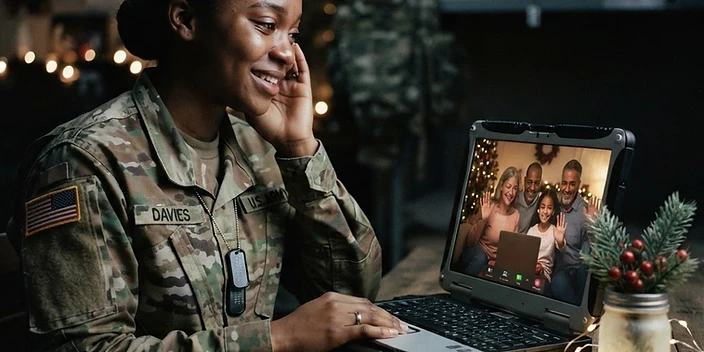
The holidays are hardest on the people who can't be home for them — and few know that like military families. Whether it's your first deployment holiday or your fourth, the season carries a particular ache when the person you love is on the other side of the world, in a different time zone, on a base or a ship instead of at your table.
This season asks military couples and families to do two hard things at once: hold the absence without letting it erase the day, and keep the connection alive across distance, danger, and delay.
What the season feels like from both sides
For those deployed: the holidays can amplify homesickness, isolation, and a painful sense of missing a year of your child's life you'll never get back. Morale events and care packages help, but a tent or a mess hall in December is a long way from home. Many service members describe guilt — for being gone, for missing moments, for the burden their absence puts on the one back home.
For those holding down the home front: the season is a solo performance. One parent doing the shopping, wrapping, school concerts, flights, and traditions while managing worry, missed calls, and the loneliness of a house with a person-shaped space in it. Military spouses often say the hardest part isn't the absence itself — it's holding the holiday together around the absence, with no one to share the weight.
Neither of you is doing it wrong. Both of you are carrying something most people never have to.
Keeping the connection alive across the distance
- Build rituals that include the absent person deliberately. A plate set at the table, their ornament on the tree, their stocking hung. Absence named is absence honored — and it teaches children that deployed still means present in the family.
- Share the day, not just the highlights. A video call during gift opening, a recorded reading of a bedtime story sent ahead, photos of the ordinary mess — not just the posed perfection. Service members say they hunger for normal, not postcards.
- Expect the connection to be imperfect. Time zones, missions, and bandwidth will interrupt the scheduled call. Have a plan B (a letter, a pre-recorded message, a gift that "opens on his behalf") so the whole day doesn't hang on one fragile connection holding.
- Write it down for later. Keep a shared journal, a running letter, a photo series of the season. Deployment holidays become family history — and the record of how you loved each other through them becomes something to hand back.
For those deployed: staying steady far from home
- Find your people on the base or ship, and do the holiday with them. Shared meals and improvised traditions with your unit are not a betrayal of home — they're how humans survive separation.
- Do something for your family's morale, deliberately. A letter sent early so it arrives on time does more for both of you than a strained call at 3 a.m. their time.
- Watch the holiday spiral. Isolation, alcohol, and the guilt-and-grief loop are the three risks of a deployment season. If you notice your mood hardening into numbness or hopelessness, military One Source, your chaplain, and your unit's mental health resources exist for exactly this. Using them is mission readiness, not weakness.
For those at home: you matter too
- Scale the season to your real bandwidth. A deployment holiday is not the year for the perfect party. Keep the traditions that hold you, drop the ones that deplete you, and outsource or simplify without guilt.
- Say yes to your village. Other military families, neighbors, your FRG — being with people who understand the life beats performing wellness for people who don't.
- Give the kids a way to love their parent out loud. Videos for the deployed parent, drawings in care packages, a map with "where daddy/mommy is" on the wall. Children do better when the absence is spoken of with love instead of tiptoed around.
- Watch yourself, too. Solo-parenting through a holiday under threat conditions is a strain response, not a character flaw. Military One Source offers free, confidential non-medical counseling for spouses and kids — including telehealth sessions during the weeks the family is apart.
A closing thought
Deployment holidays are a paradox: the worst season of the year for being apart, and often the one military families later remember with the most pride — because of what they proved about themselves. The lights still go up. The traditions bend and hold. And a family that can keep loving each other across an ocean and a time change is a family built on more than proximity.
This year will end. Until it does, keep each other woven into the day — and let the support that exists for military families carry what you shouldn't have to carry alone.